How to use the DEX – Spot table
In short
- Each row is a token whose DEX price differs from the spot price on an exchange, with the spread between them in percent.
- A positive spread means the token costs more on the exchange than on the DEX; a negative one means the DEX is higher.
- Before trading, check deposits and withdrawals, DEX liquidity, fees, gas and slippage.
The DEX – Spot table shows tokens whose price on a decentralized exchange (DEX) differs from the spot price on a centralized exchange (CEX). For each pair you see both prices, the spread in percent, DEX liquidity and the deposit and withdrawal status. Only prices with the same contract address are compared. The table is in the web version of DEX – Spot.
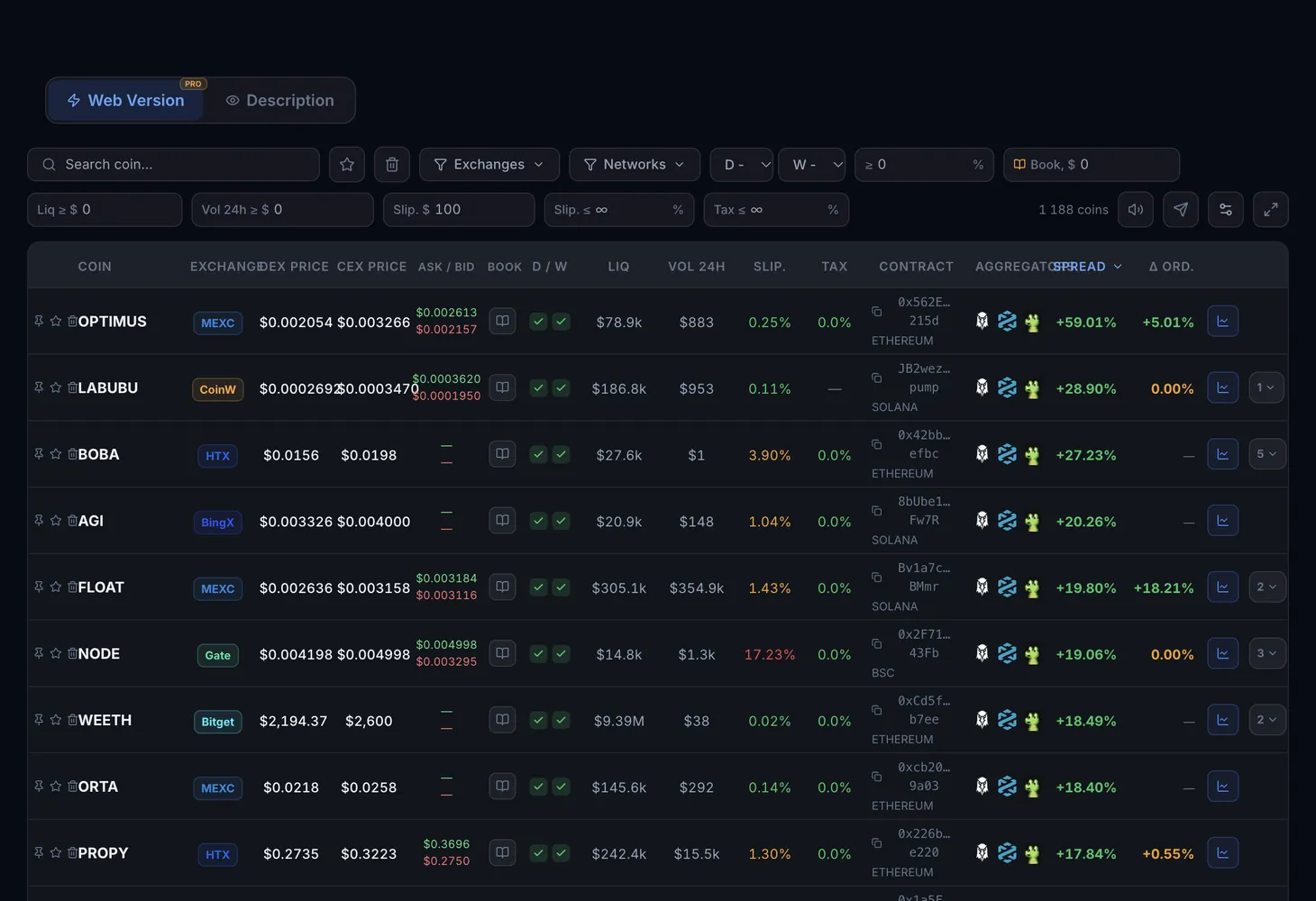
How the table is organized
The table lists every DEX ↔ CEX spot pair. One row is one token on one exchange.
| Element | What it shows |
|---|---|
| Coin and network | The token's ticker and the blockchain where it trades on a DEX |
| Exchange | The centralized exchange whose spot price is compared with the DEX |
| DEX price | The aggregated DEX price of the token by its contract |
| Spot price | The last price of the token on the exchange's spot market |
| Spread | The difference between the spot price and the DEX price in percent |
| Ask / Bid | The best selling price and the best buying price in the exchange order book |
| CEX order book | How much you can buy or sell on the exchange close to the price |
| Δ by orders | The price difference taking order book orders into account |
| Liquidity | The token's liquidity on the DEX |
| D / W | Deposit (D) and withdrawal (W) status of the token on the exchange |
| Contract | The token's contract address |
| Links | Shortcuts to DexScreener, DexTools, GMGN, OKX Web DEX and Binance Alpha |
| Transfer | For routes that move the token between networks: transfer chain, its liquidity and volume, slippage, fee and bridge time |
The sign of the spread tells you the direction. A positive spread means the token costs more on the exchange than on the DEX. A negative spread means the DEX is more expensive.
Tokens need at least $45K of DEX liquidity to appear in the table, so coins with tiny pools are filtered out in advance.
Filters, sorting and alerts
- Exchanges: keep only the CEXs you work with.
- Minimum spread: hide pairs with a small price gap.
- Minimum liquidity: hide tokens with shallow DEX pools.
- D/W: three options: deposit-open only, withdrawal-open only, or both at once.
- Grouping by contract: shows every exchange for one coin in a single click.
- Sorting: by spread, liquidity and exchange.
- Sound alerts: in the browser, for both positive and negative spreads.
- Table settings: hide the columns you do not need and drag the rest into a convenient order. Changes apply straight away.
You can pin a row, add it to favorites or send it to the trash. If you hide the Actions column, these marks are no longer available.
How the spread is verified
A spread in DEX – Spot goes through three checks:
- A preliminary calculation from the exchange's last price.
- An order book check: a volume-weighted average price on real volume up to $10K.
- A final re-check of the price through the DEX.
The maximum spread is calculated only across exchanges with the required status open: deposits for a positive spread, withdrawals for a negative one.
How to use the table
Cut the noise
Set a minimum spread and a minimum liquidity. The table keeps only pairs with a visible gap and a pool that is deep enough.
Work out the direction
With a positive spread you buy the token on the DEX, move it to the exchange and sell on spot. With a negative spread you buy on the exchange, withdraw and sell on the DEX.
Check D and W
A positive spread needs open deposits, otherwise the token cannot reach the exchange. A negative spread needs open withdrawals. The D/W filter does this check for you.
Gauge liquidity
DEX liquidity decides how much you can buy or sell without noticeable slippage. The higher it is, the larger the possible entry and the more reliable the price.
Count the costs
Open the token through a quick link and subtract exchange and DEX fees, gas and slippage from the spread. If almost nothing is left, skip the trade.
To see which sections your plan includes, open the Pricing page.
For the theory, read the course lesson What is DEX arbitrage and the glossary entries on spread and the order book. Related guides: DEX – Futures and Crosschain.
Questions and answers
What do positive and negative spreads mean?
A positive spread means the exchange spot price is above the DEX price: you buy on the DEX and sell on the exchange. A negative spread means the DEX is higher: you buy on the exchange and sell on the DEX.
Why is there a spread I cannot profit from?
Usually deposits or withdrawals are closed in the direction you need, the pool is thin, or fees, gas and slippage eat the gap. Check the D / W and Liquidity columns and count your costs before trading.
What is triple spread verification?
The spread is first calculated from the exchange's last price, then checked against the order book using a volume-weighted average price on real volume up to $10K, and finally the price is re-checked through the DEX.
Is the table suitable for beginners?
The data is ready to read: spreads are calculated, statuses are checked and links are built in. The arbitrage itself still requires understanding how DEXs, bridges and spot exchanges work.