DEX Dumps: how to find token crashes on DEX and filter out scams
In short
- The section shows tokens that crashed on decentralized exchanges, with price, liquidity, market cap and change over intervals from 1 minute to 24 hours.
- The On CEX exchanges mark and a liquidity threshold help separate known tokens from scams and empty pools.
- A crash is not always an opportunity. The token may never recover, and selling it from a thin pool can be hard.
DEX Dumps tracks sharp token crashes on decentralized exchanges. For each token you see how far the price fell, the pool's liquidity, market cap and volume, the chain it trades on and whether it is listed on centralized exchanges. The section helps you find potential entry points during panic selling while filtering out scams and low-liquidity tokens.
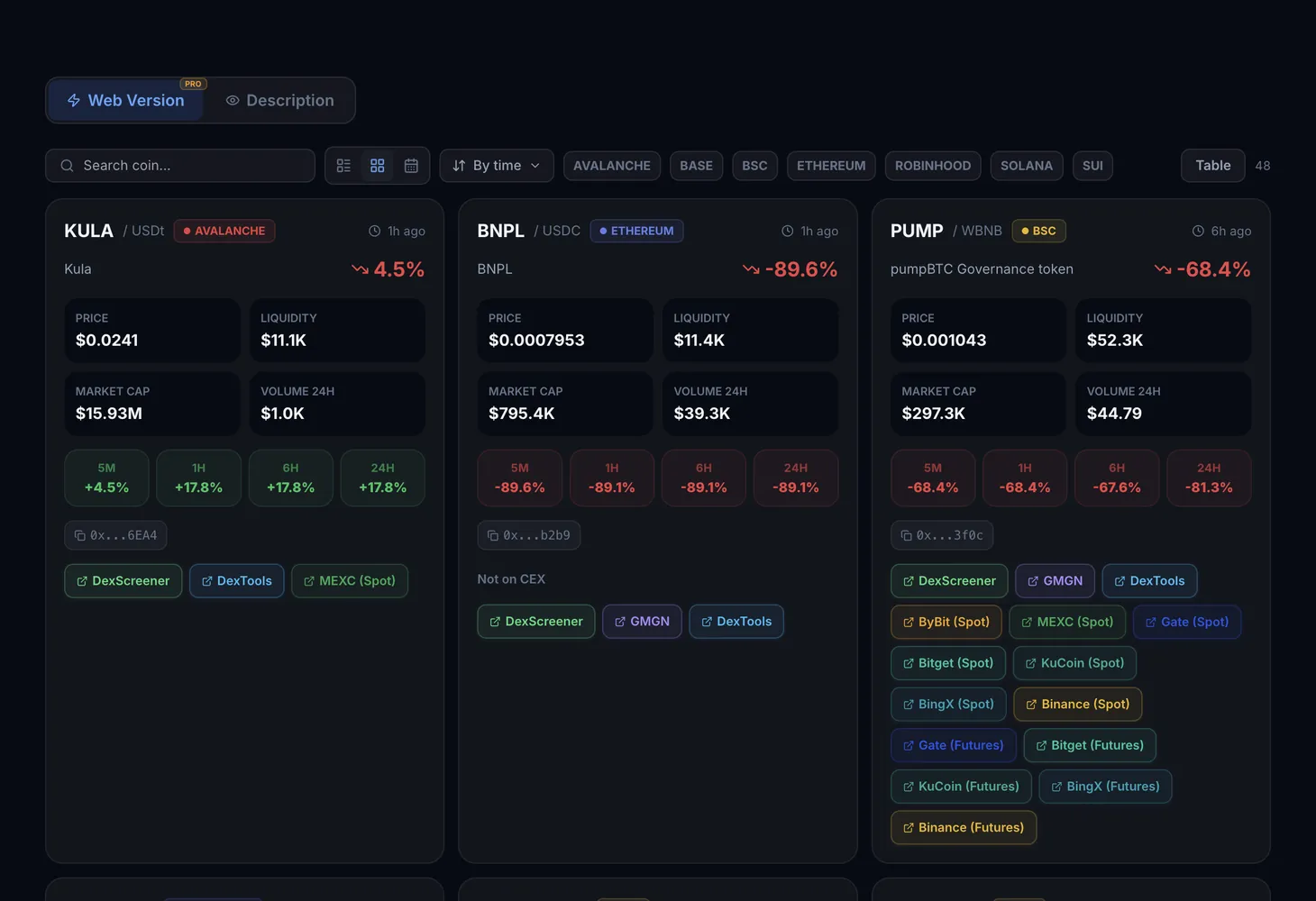
What is shown for each token
| Element | What it shows |
|---|---|
| Coin | The token's ticker, with favorite and trash buttons |
| Change | How far the price fell |
| 1m, 5m, 15m, 1h, 24h | Price change over each interval |
| Price | The current price in the pool |
| Liq. | Pool liquidity: how much money sits in it |
| Market Cap | The token's market value |
| Vol. | Trading volume over 24 hours |
| Chain | The blockchain the pool trades on |
| Contract | The token's contract address |
| On CEX exchanges / Not on CEX | Whether the token trades on centralized exchanges |
| Links | Go to the pool and to exchanges |
Signal time is shown as "s ago", "m ago" or "h ago", and entries are split into Today and Yesterday.
Supported chains include Ethereum, Solana, BSC, Base, Arbitrum, Polygon, Tron, Avalanche, Optimism, Blast, TON, Aptos and others.
Filters and sorting
- Search coin: find a token by ticker.
- All chains: keep one blockchain.
- Liq. ≥: the minimum pool liquidity.
- Sorting: By time, By dump %, By liquidity, By market cap.
- Table: show the data as a table.
- Favorites and Trash: tokens you marked and tokens you hid.
- Reset returns filters to default, Show more loads more entries.
The number of tokens found is shown above the list.
How to check a dump
Filter out empty pools
Set Liq. ≥ and pick a chain if you need one. A token with a large pool is a very different story from an unknown token with a handful of dollars in the pool.
Sort the list
By time shows fresh crashes, By dump % the deepest ones, By liquidity and By market cap bring large tokens to the top.
Check CEX presence
A token marked On CEX exchanges has gone through listing on centralized venues and has a community and volume. Such a token is less likely to be a scam and more likely to recover.
Study the token
Check the contract and look at the 1h and 24h change: is the fall continuing or slowing down. Use the links to open the pool and the exchanges.
Pick a side
You can buy at the bottom expecting a recovery or, if the token has futures, consider shorting a continued fall. The decision and the risk are yours.
Plans
The section page has a Try PRO button: full access to the tool comes with the Pro plan. Plan details are on the Pricing page.
DEX theory is in the DEX arbitrage course, and sharp moves are covered in the Pumps and dumps course. Terms: DEX and slippage. Centralized exchanges have their own tool, CEX Pumps - Dumps.
Questions and answers
How do I know whether a dump is worth entering?
Look at pool liquidity, market cap, 24h volume, price change by interval and CEX presence. The larger the pool and the better known the token, the lower the risk of a scam.
Why does the On CEX exchanges mark matter?
A token that trades on major centralized exchanges has gone through listing and has a community and volume. Its chance of recovering after a dump is higher.
Can I short dumps?
Yes, if the token trades on futures. You decide whether to buy at the bottom or short a continued fall.
Which chains are supported?
Ethereum, Solana, BSC, Base, Arbitrum, Polygon, Tron, Avalanche, Optimism, Blast, TON, Aptos and others. Pick a chain with the All chains filter.